


Longtime readers know that I often use the term, “E-Ticket ride,” to refer to attractions. It occurred to me that many of you may be wondering what the heck I’m talking about. While it’s more or less part of the mainstream lexicon, the shorthand phrase may be too inside baseball–or in this case, inside theme parks–for some. With the relatively recent introduction of tickets that can be stored and used electronically (as opposed to a hard copy, paper tickets) for admission to concerts, sporting events, and other venues as well as parks, the original meaning of “E Tickets” has been muddied. So, let’s step back in time and explore the derivation and evolution of the term as it relates to parks.
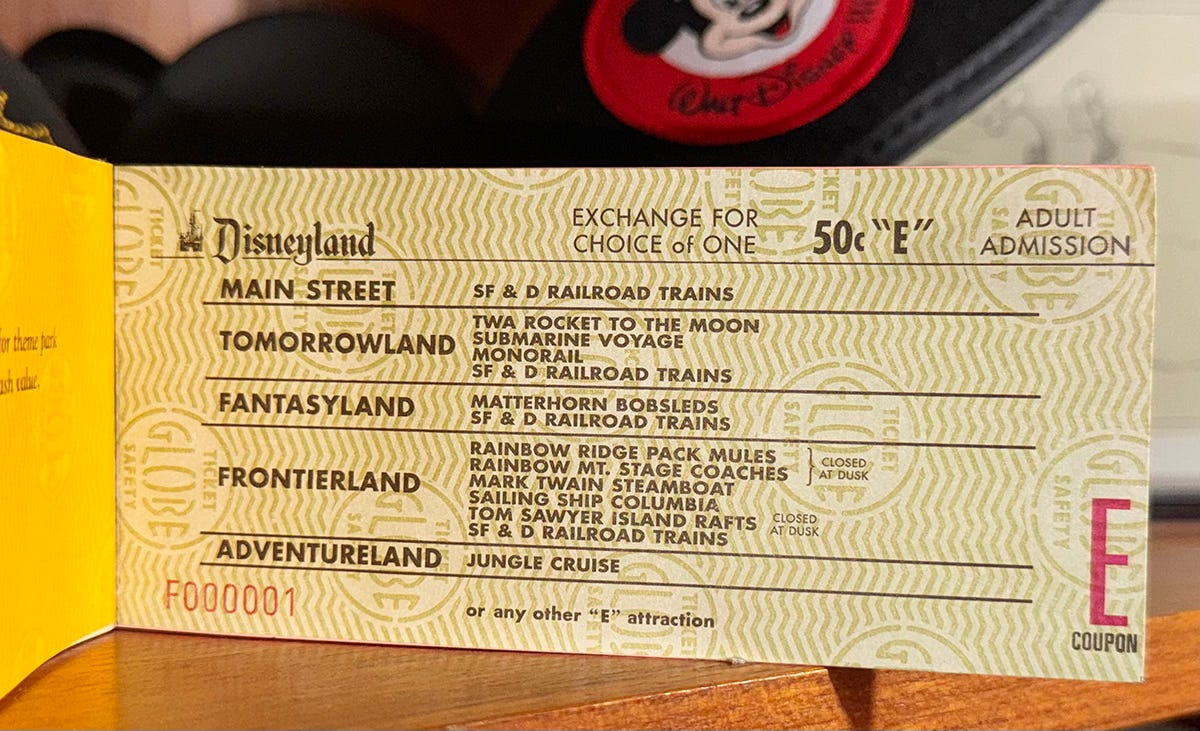
In the early days of Disneyland and Disney World, guests paid a nominal fee to enter the parks and then purchased individual tickets for the rides and attractions. The parks also offered books of tickets which bundled them together at a discount price. Disney graded its rides from “A” through “E” and offered corresponding tickets.
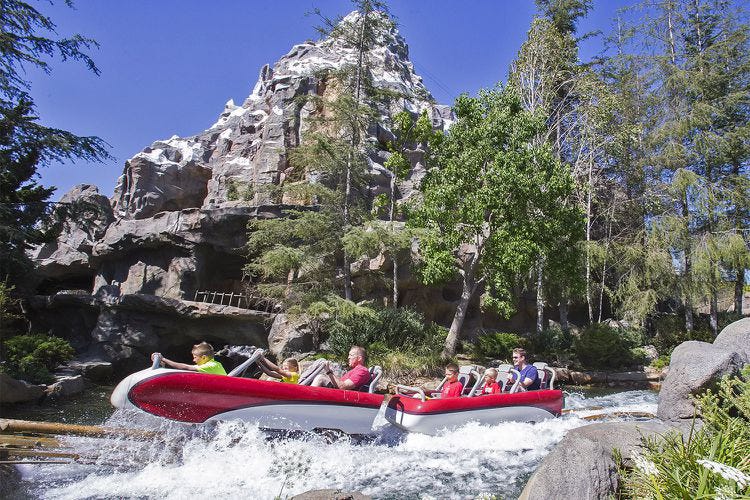
Those labeled “A” rides, such as the Fire Engine that traveled up and down Main Street U.S.A., were the lowest-tier and least expensive attractions. They were originally priced at 10 cents. Moving up the alphabet, the attractions were increasingly popular, sophisticated, and cost more to ride. An “E” ticket, which allowed admission to rides such as the Matterhorn Bobsleds and Pirates of the Caribbean, were the most coveted. When visitors used their ticket books, they would ration the “E” tickets carefully. First introduced in 1959, an E Ticket was valued at 50 cents (and admission to the park cost $4.50 for adults).
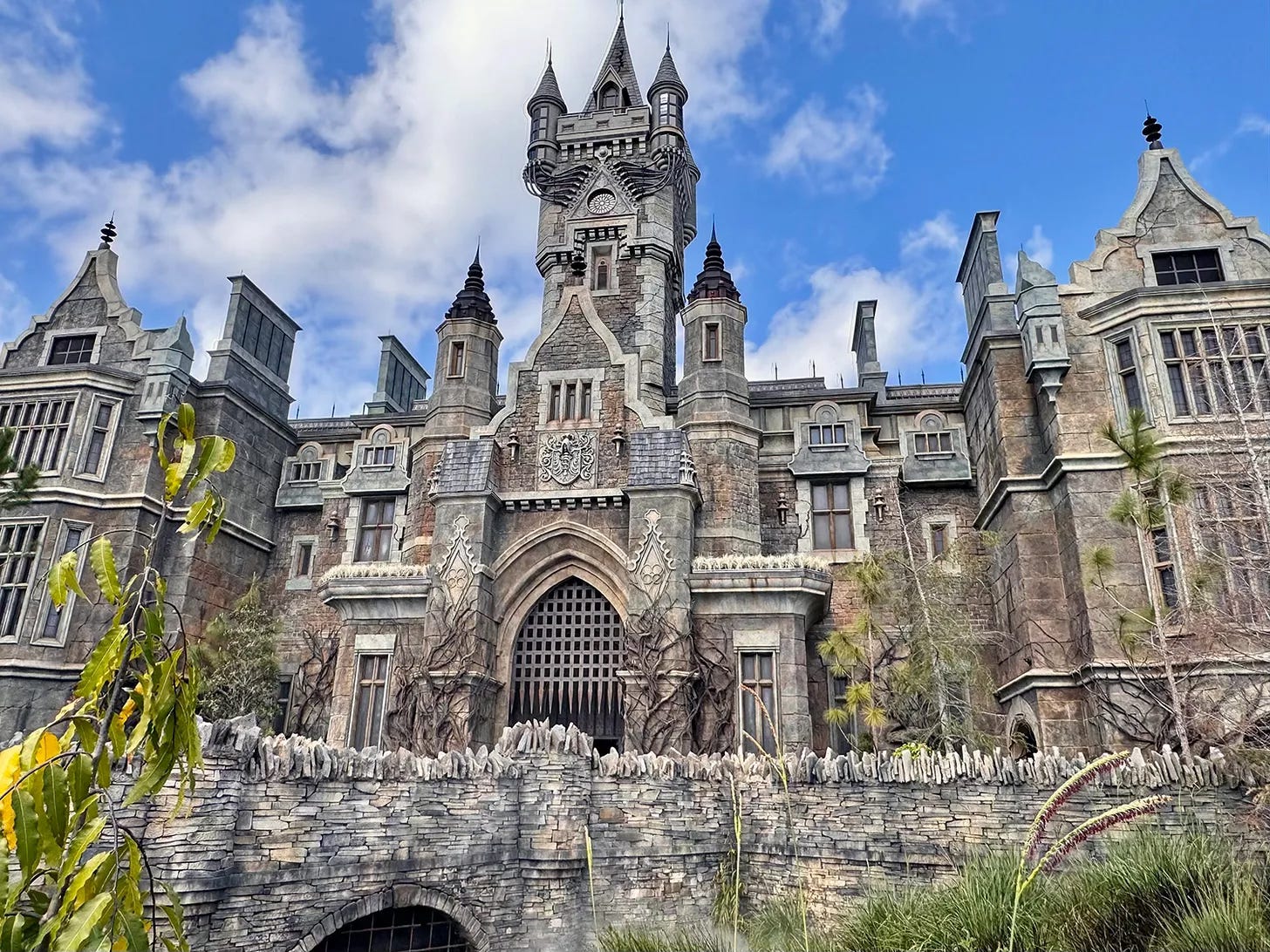
By the early 1980s, Disney phased out the use of individual tickets and instituted a pay-one-price policy with a jacked-up admission fee that included unlimited rides. Even though the tickets themselves are long gone, the term, “E Ticket,” endures. And it’s not confined to Disney parks. Any marquee attraction that aspires to theme park greatness, such as Epic Universe’s Monsters Unchained: The Frankenstein Experiment or Danse Macabre at Efteling theme park in the Netherlands could be considered an E-Ticket ride.
In addition to referring to the creme-de-la-creme of Disney attractions and park rides in general, “E Ticket” can also be used to describe anything that is considered to be among the best (or biggest, most exciting, etc.) of its kind. It’s a stand-in for descriptors such as “elite,” “headliner,” or as we are fond of saying in Massachusetts, “wicked awesome.”
By the way, nearly all amusement parks and theme parks used tickets up until the 1980s. Some would offer a pay-one-price option, but a pay-per-ride ticket system was the predominant business model. Unlike Disneyland and Disney World, many parks offered free admission and had an open-gate policy. Instead of using alphabet-coded tickets, most parks would vary the number of tickets it required to board its rides. Patrons might have to fork over one ticket for a low-profile kiddie ride, for example. It might take three tickets for a more thrilling flat ride, however, and five tickets to score a seat on a park’s signature roller coaster (its version of an E-Ticket ride).
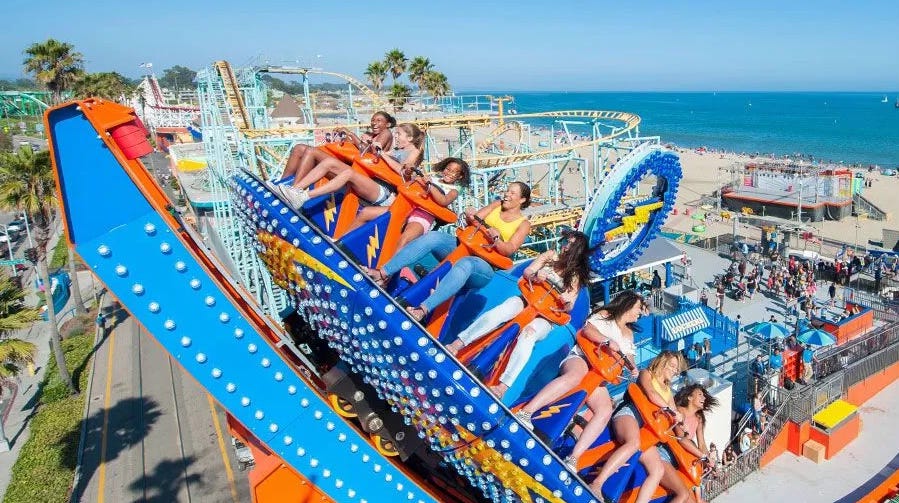
There are still a handful of parks that use a pay-per-ride ticket system. They are mostly traditional amusement parks such as Knoebels in Pennsylvania and the seaside park, Santa Cruz Beach Boardwalk in California. Those and other pay-per-ride parks do not typically charge admission to enter. In general, carnivals and fairs still use a pay-per-ride system as well.
In some ways, the ticket system could be considered more equitable for visitors who only want to get on a few attractions. Parents or grandparents, for example, may want to take their children or grandchildren to enjoy a park’s rides, but have no intention of boarding any themselves. Then again, the pay-one-price model allows ride warriors to cram in as many rides, E-Ticket or otherwise, as they can over the course of a day. For them, the elimination of tickets means they don’t have to keep reaching for their wallets, and they can get great value by paying once at the gate.
Interestingly, E Tickets have come full circle in a way. In addition to charging to get into its parks (and, as park fans know, it costs considerably more than the 1959 price of $4.50 these days), Disney now offers Lightning Lane Single Passes to reserve times on its most popular attractions, such as Guardians of the Galaxy: Cosmic Rewind at Epcot. It’s not required, but without the optional pass, standby lines for the crazy-popular rides can swell to two hours or more. And like park admission, the prices for Lightning Lane Single Passes are significantly higher than the original E Tickets.
Have you ever visited a park that uses individual ride tickets? Would you prefer individual ride tickets to a pay-one-price model?