


Before we jump into today’s topic, please consider checking out the most recent episode of CoasterRadio (tagline: The Original Theme Park Podcast). As has been a longstanding and wonderful annual tradition, I joined hosts Mike Collins and E.B. as a guest to run down the new rides, attractions, lands, and developments on the way this year. We talked about major highlights, such as NightFlight Expedition at Dollywood and Fast & Furious: Hollywood Drift at Universal Studios Hollywood, along with a host of other news, opinions, and hot takes. You can find the audio podcast here. There is also a video version of the episode on YouTube here.
Theme park or amusement park? Have you ever wondered whether there is any difference between the two terms?
Some might argue it’s one of those you-say-tomato-and-I-say-tomahto things. However, park fans (a group of which we are proud members) beg to differ. There are differences, but they can be subtle, and there is often plenty of overlap. Before we call the whole thing off, let’s parse the terms and shed some light. You might want to fasten your seat belts and lower your lap bars; we could be in for a bumpy ride.
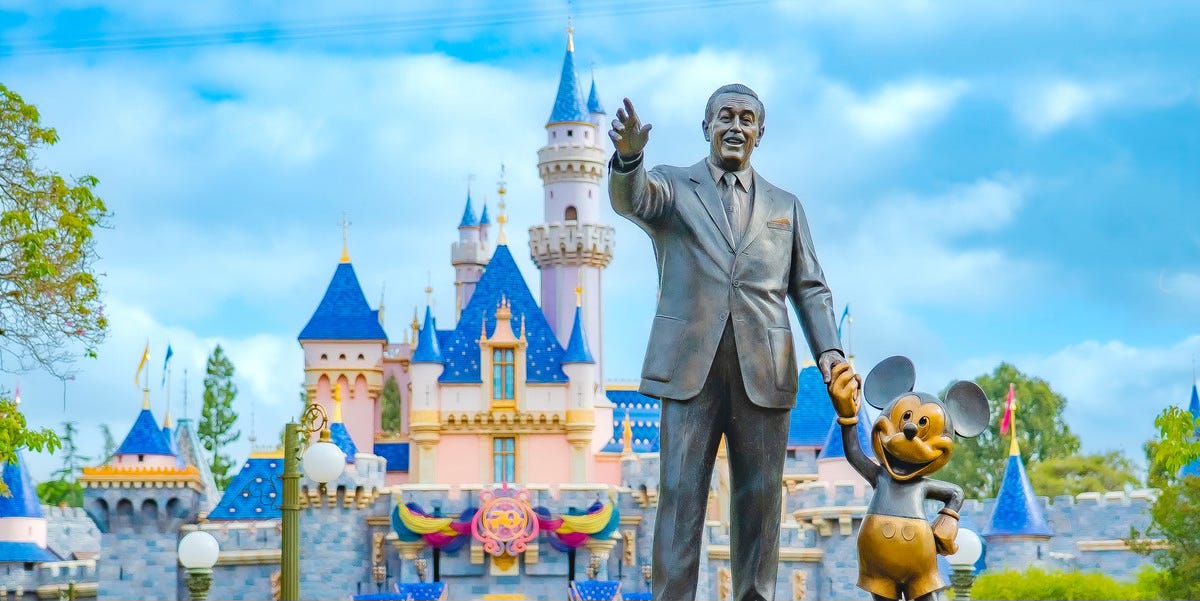
Storytelling is a critical component at theme parks
"To all who come to this happy place, welcome. Disneyland is your land." When he uttered those words in 1955 at the grand opening of Disneyland, Walt Disney ushered in a new era of entertainment. Most would agree that the California park is the original theme park and serves as a template for all the theme parks that have followed. (Interestingly, Disney did not coin the term “theme park,” and it did not exist when Disneyland debuted. But the company subsequently embraced the designation.)
The basic formula that Disney pioneered was to take the common rides found at amusement parks—roller coasters, flat rides, carousels, dark rides, and the like—and use them to tell stories. That is the essence of a theme park. By incorporating whimsical architecture, color, landscaping, characters, and other elements, park visitors become active participants in stories rather than passive passengers on mechanical rides.
Further, Disney divided his park into themed lands, and created the attractions within those lands to tell a larger story. Instead of experiencing one overriding theme, Disneyland guests can travel to Frontierland, Tomorrowland, Fantasyland, and other fantastic places. By using the storytelling techniques his filmmakers mastered, including music, lighting, composition, and framing, and adapting them to three dimensional spaces, Disney was able to immerse (a term that park designers frequently embrace) his guests in all-encompassing adventures. Disney’s Imagineers and their colleagues in the industry even use movie language, such as long shots, medium shots, and close-ups, when developing lands and attractions.
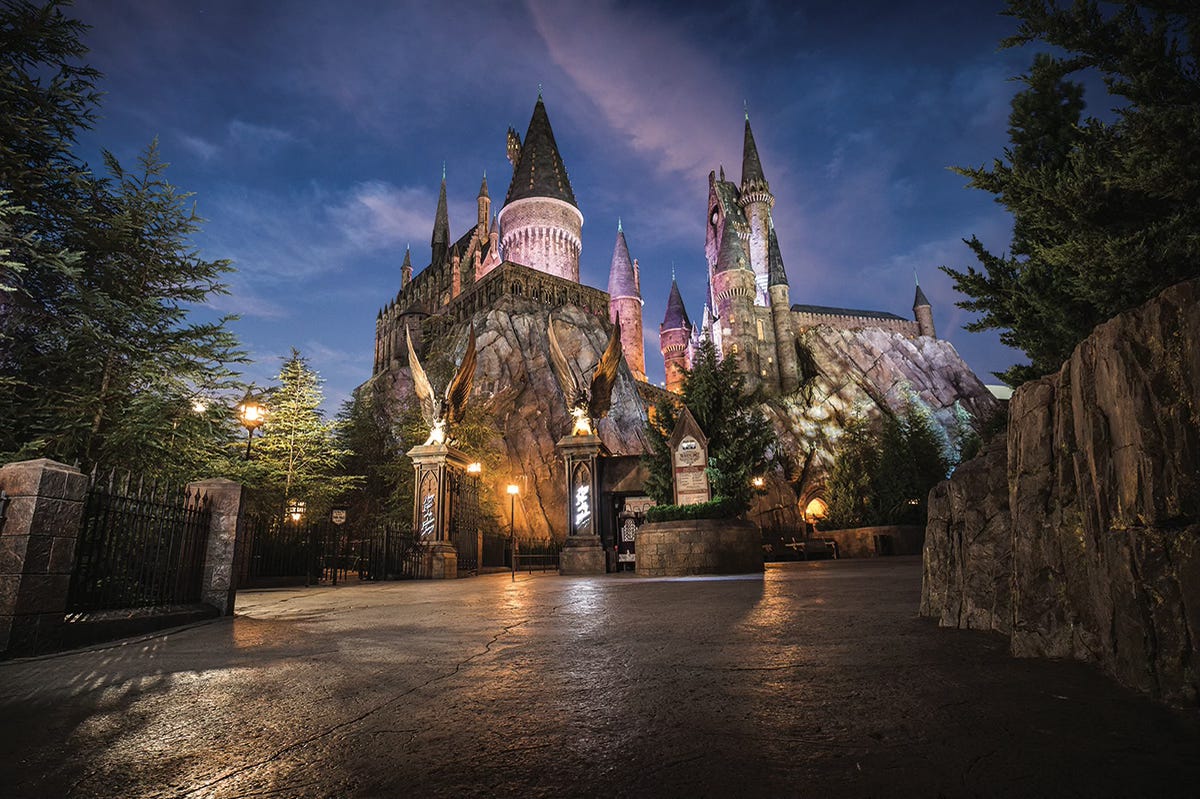
Sometimes, as with Peter Pan’s Flight or The Amazing Adventures of Spider-Man, theme park attractions tell linear stories and use established characters. Other times, as with Toy Story Mania!, the narratives are less defined, but the attractions still stick with specific themes and use storytelling techniques—and, more often than not, dazzling technology—to engage and delight visitors.
The level of immersion increased considerably when Universal Orlando opened the Wizarding World of Harry Potter. Instead of a single attraction within a generic land, the entire land is themed to one element—in this case Harry and his buddies. And everything in the land, including the food and merchandise, strictly adheres to the theme. Even the employees play along with the Wizarding vibe. Disney responded with single-themed lands such as Cars Land, Toy Story Land, and Pandora – The World of Avatar. They are all lushly themed.
But Disney kicked it up a notch with the ultra-themed Star Wars: Galaxy’s Edge. Every last detail in the land is true to George Lucas’ mythology. Heck, even the signs for the cantina and the shops are in Aurebesh, the language of the Outer Rim territories. (Fortunately, you could download an app to translate the language you encounter in the land into English.)
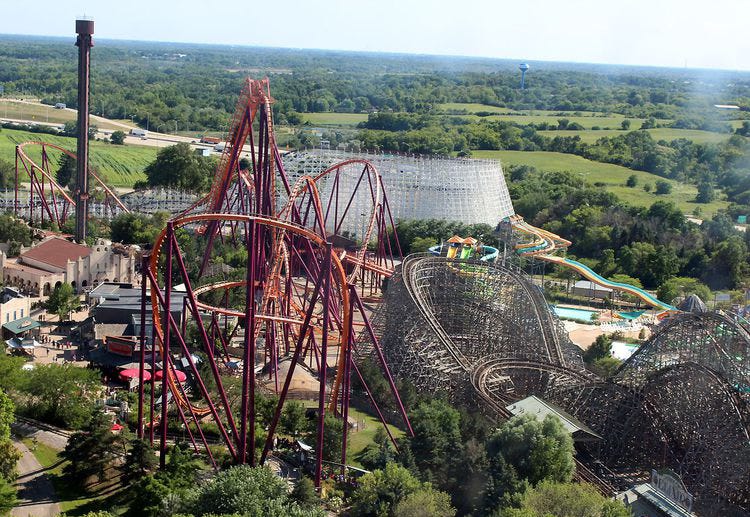
Amusement parks pour on the thrills
On the other hand, amusement parks generally skip any storytelling pretense and sometimes don’t have any defined lands. They usually feature a random collection of roller coasters and other rides. Taking their cue from Chicago’s 1893 world’s fair, the World’s Columbian Exposition, and its Midway Plaisance as well as New York’s Coney Island and its boardwalk, amusement parks typically present their rides along one or more midways. Instead of trying to immerse visitors in unified, themed experiences, the midways usually offer rides, games, food concessions, and stores that have nothing in common.
Loud noises, including the screams of riders, help create high-energy environments. There are generally loads of rides that offer thrills for thrills’ sake–and not to tell any larger story–at amusement parks. Even the “kiddie” rides, which go easy on the thrills, entertain their young passengers primarily with spinning and other action-filled experiences. Examples of amusement parks include Cedar Point in Ohio, Lake Compounce in Connecticut, Knoebels in Pennsylvania, and Canobie Lake Park in New Hampshire, to name a few.
In my estimation, many parks fall into a gray area somewhere in between a theme park and an amusement park. Six Flags, for example, describes its locations as “theme parks.” While the parks do include themed lands such as “Yankee Harbor” and “Yukon Territory,” their design is often rudimentary. The rides in each land typically offer little to no theming. Slapping images of superheroes or cartoon characters on rides often passes for storytelling at parks.
Some parks can surprise with individual attractions such as the highly themed Monster Mansion (see video above) at Six Flags Over Georgia. A number of Six Flags parks offer Universal-like Justice League: Battle for Metropolis rides. So, it’s a mixed bag. In general, however, I place Six Flags in the amusement park category.
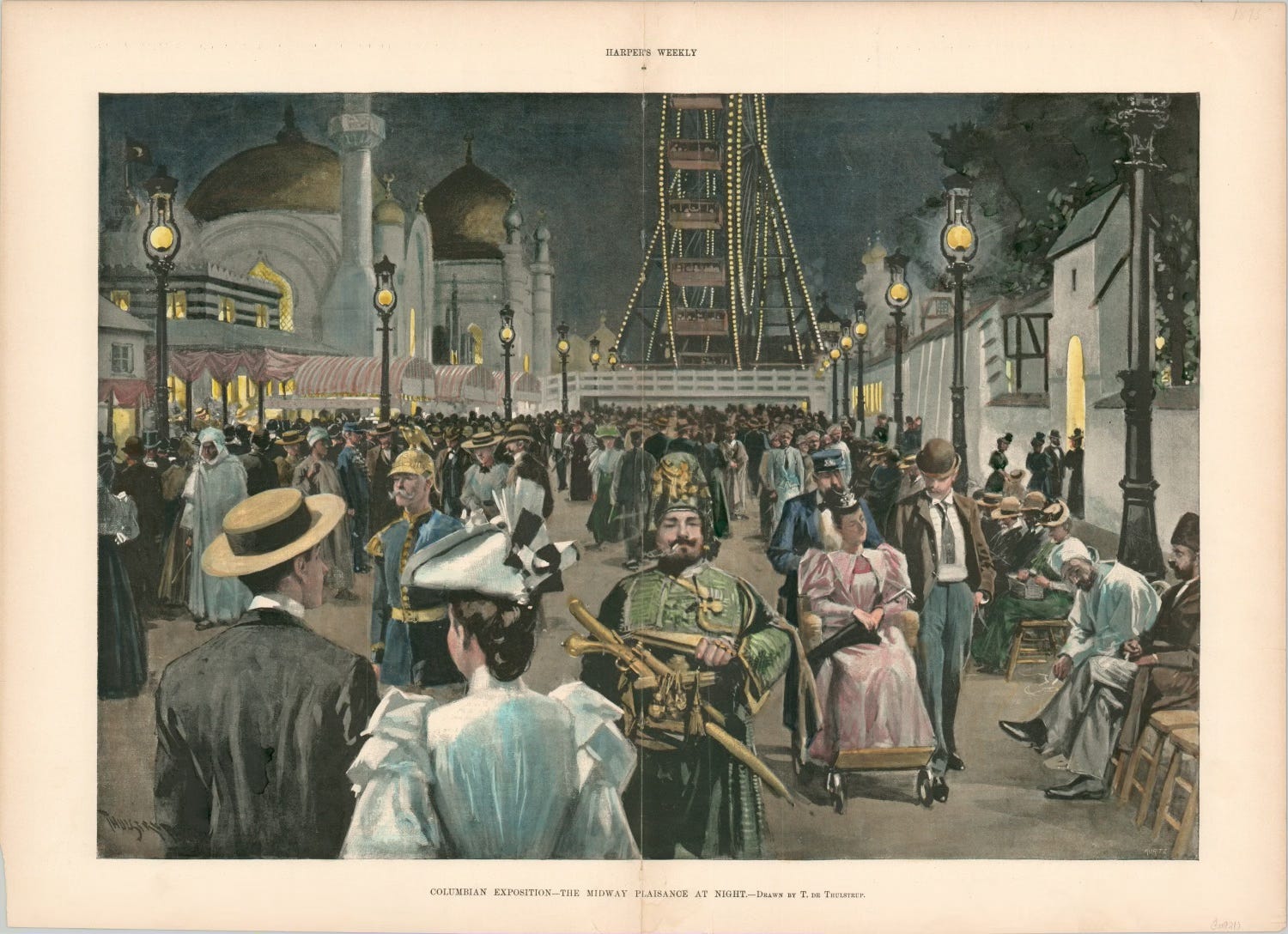
Even early amusement parks included storytelling
It gets murky elsewhere as well. There were even hints of the theme parks to come in the World’s Columbian Exposition, the predecessor to modern amusement parks. It included a grand White City with ornate neoclassical buildings and lovely grounds designed by noted landscape architect Frederick Law Olmsted. Coney Island, arguably the prototypical amusement park, included theme park flourishes in its heyday.Examples include the Scenic Railway, an early roller coaster that included themed dioramas past which passengers rode, and an elaborate nighttime show that included simulated burning buildings and other effects.
Although Disneyland is generally acknowledged as the model for modern day theme parks, there are parks that preceded it that could also be called theme parks–or at least theme park-like. For example, there were parks with holiday themes, such as the circa-1952 (three years before Disney opened his park) Santa’s Village in New Hampshire. It is still delighting families today with its compelling Christmas theme.
There are no federal guidelines or industry standards to determine what distinguishes an amusement park from a theme park. And there are plenty of parks that straddle the line. In general, however, if its attractions attempt to tell stories and are part of larger, unified themes, it's a theme park. If it is mostly a mishmash of rides and its primary goal is to deliver thrills, it's probably an amusement park.
Do you differentiate the terms, “amusement park” and “theme park?” Are Six Flags locations theme parks or amusement parks?
I definitely expect some attempt at theming for it to be a Theme Park; just naming an area doesn't count. You need to at least do some work to make a coherent setting that even if people can't name it, they can piece it together, even if it's a simple as a boardwalk or a "main street". Just landscaping wont cut it, unless you're really going out, like with an Alice in Wonderland topiary theme.
I tend to agree with your assessment. For my personal definition of theme park, either the entire park needs to fall under a coherent theme, or each individual section in that park needs to be themed. This is the reason I think my home park of Carowinds falls into that gray area. There are themed lands in Carowinds (Camp Snoopy, Aeronautica Landing), but they sit along sections that aren't themed at all. I hesitate to call something a "theme park" in which theming is only partially implemented.
That said, I don't get too caught up in the semantics. They all exist to entertain, and it's great to see regional parks getting into more elaborate theming. Going back to Carowinds, I've been particularly happy with their attempt to correct some of their hopelessly mish-mashed theming of the past and moving towards a general "Carolinas" theme.
Also wanted to say that I very much enjoyed your appearance on CoasterRadio as always, Arthur. Every year I look forward to your take on all the new rides. Your enthusiasm and fandom for the industry always shines through.