


The original roller coasters were made of wood, but today there are fewer wooden coasters overall compared to their steel counterparts. Because tubular pipe is a more pliable material, there is a wide variety of steel roller coasters. Wood may be less flexible, but there are an interesting variety of “woodies” to explore. Let’s run down some types of wooden coasters. Then go seek them out and ride the rails.
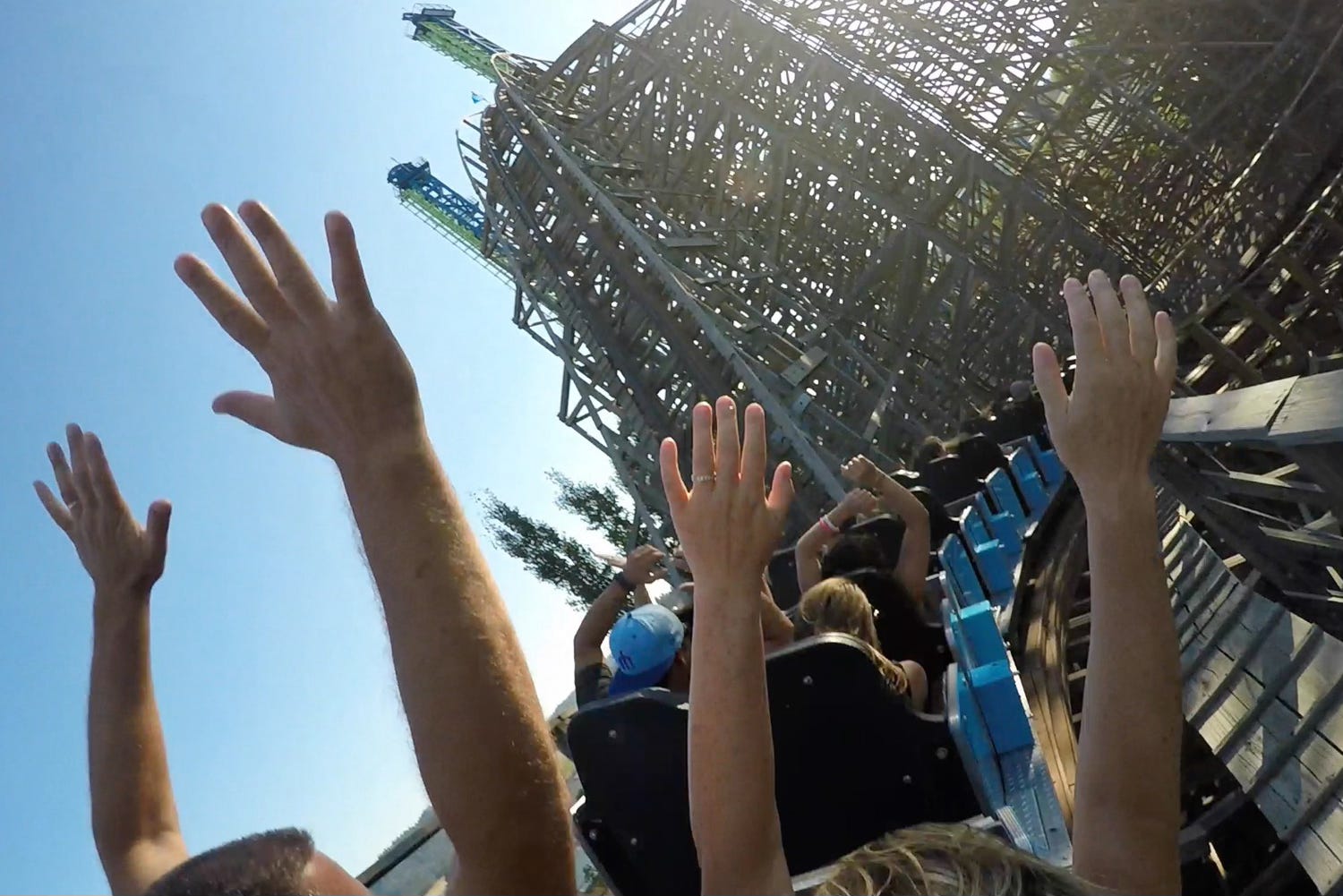
Twister coaster
A twister coaster is so named because its track twists and turns into itself. Because of all the turns, twister coasters can be built on relatively small plots of land. With all of the twists and curved track, they usually deliver lots of lateral G-forces that can slam passengers to-and-fro sideways. When riders are racing along a twister coaster, it may appear that they might not clear the structure when they enter it. This is known in the industry and among enthusiasts as a “head chopper.” (Lovely imagery, right?)
Examples of twister coasters include Thunderhead at Dollywood in Tennessee and Tremors at Silverwood in Idaho.
Out-and-back coaster
A popular type of wooden coaster is the out-and-back. As the name implies, the track takes passengers out to the halfway point, turns around, and heads back to the station. Because of their configurations, out-and-backs can take up a lot of real estate. They typically do not include many twists or turns, instead offering lots of hills that can deliver sweet pops of out-of-your-seat airtime. Variations include double out-and-back and triple out-and-back coasters.
Examples of out-and-back coasters include Shivering Timbers at Michigan’s Adventure, which travels a half-mile out and a half-mile back, and El Toro at Six Flags Great Adventure in New Jersey. Interestingly, El Toro, which was built by Intamin, uses prefabricated wooden track.
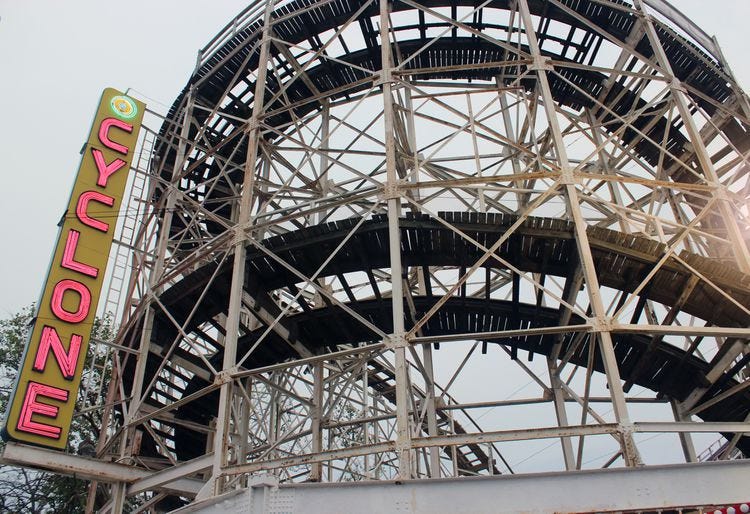
Cyclone
A specific type of twister coaster, cyclone coasters pay homage to the original Cyclone at Brooklyn’s Coney Island. Built in 1927, the Cyclone is among the most famous rides in the world. Deemed a National Historic Landmark, it is still operating to great acclaim. The famous ride actually features a steel structure. But it is considered a wooden coaster because of its traditional wooden coaster track. All other cyclone coasters reproduce the original’s layout.
There used to be a number of cyclone coasters, including Psyclone at Six Flags Magic Mountain in California. Three remain today, including Viper at Six Flags Great America near Chicago.
Figure Eight
In the early 1900s, when coasters first became popular, figure eight track layouts were quite prominent. In fact, many coasters were (unimaginatively) named "Figure 8.” As you might imagine, their layouts trace a figure-eight pattern.
There are still plenty of steel figure eight coasters, but the only remaining woodie that’s still operating is Swamp Fox at Family Kingdom in South Carolina.
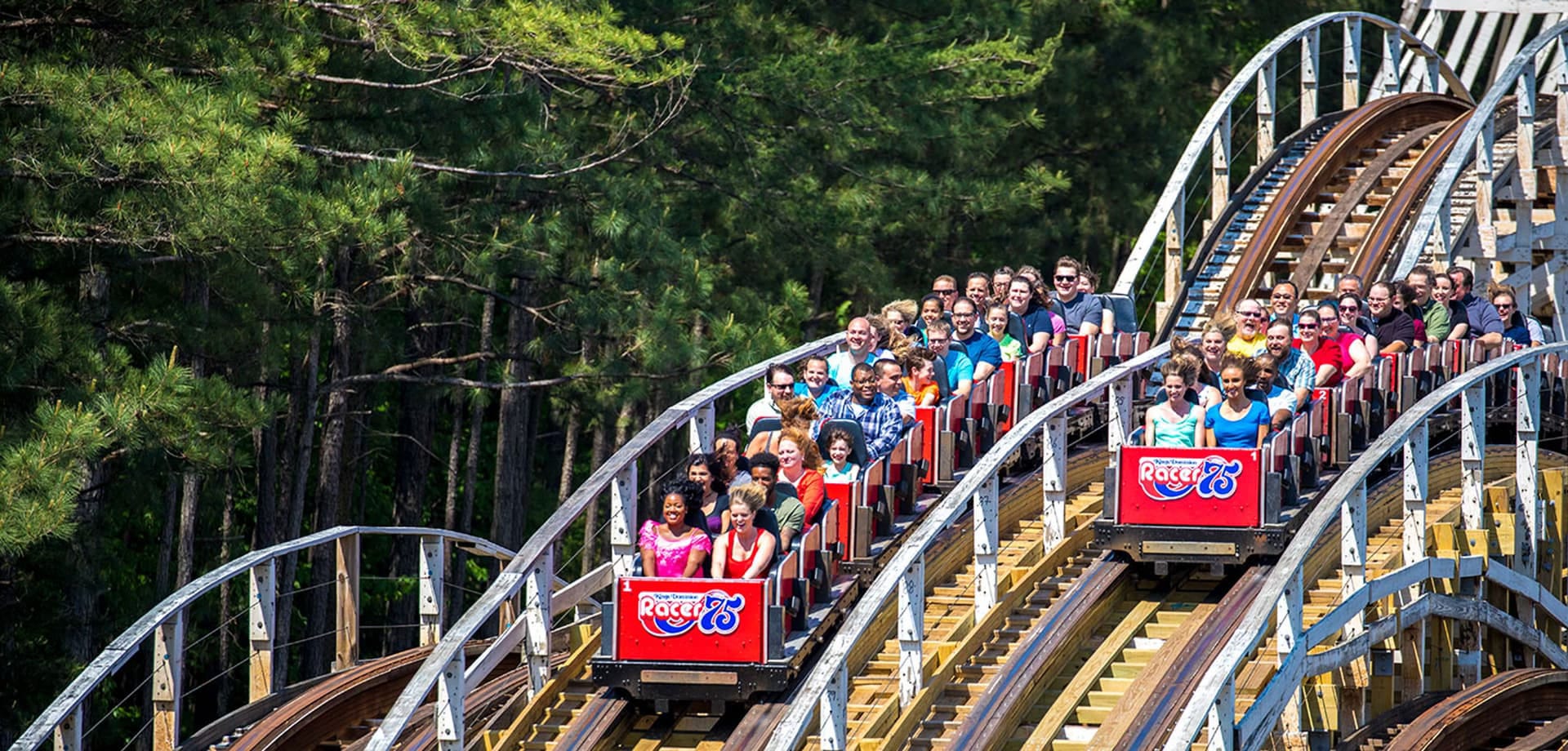
Twin coaster
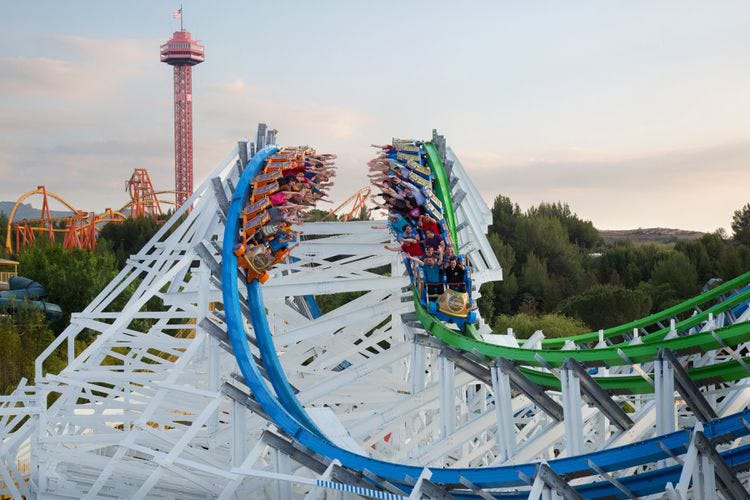
Twin coasters have two tracks and typically dispatch two trains at the same time that “race” one another. They are also known as racing coasters. The two tracks are usually mirror images, and they generally follow the same course alongside one another for most of the ride. A close cousin of the twin coaster is the Möbius coaster, which features two trains on what appears to be two tracks, but is actually one continuous loop of track. Racer at Kennywood in Pennsylvania is a (wonderful!) classic Möbius coaster.
Examples of wooden twin coasters include The Racer at Kings Island in Ohio and Racer 75 at Kings Dominion in Virginia.
Topper Track coasters
The coaster types listed above all focus on track layouts. For this category of wooden coaster, we turn to the track itself. Nearly all wooden coaster tracks incorporate a stack of wooden track pieces with a thin steel rail embedded in the top layer onto which the trains’ wheels run. In 2013, the innovative ride manufacturer Rocky Mountain Construction (RMC) introduced Topper Track. Its coasters feature a thick band of steel rail that completely covers the entire wooden stack. The more robust track allows the coasters to go higher and faster while remaining comparatively smooth. It also allows them to include inversions that turn passengers upside down, which was novel for modern-day wooden coasters when the first Topper Track coaster, Outlaw Run at Silver Dollar City in Missouri, opened.
There are three other Topper Track coasters operating, including Goliath at Six Flags Great America in Illinois, Wildfire at Kolmården in Sweden, and Lightning Rod at Dollywood. Lighting Rod had much of its Topper Track replaced in 2021 with I-Box track (see hybrid wooden and steel below).
Bobsled
Bobsled coasters also focus on the track. Specifically, they do not include any rails, but instead use a trough through which trains race, much like a bobsled. Wooden bobsled coasters were popular in the first half of the 1900s. Today, there are a number of steel ones operating, but the only wooden bobsled coaster is the retro Flying Turns at Knoebels in Pennsylvania.
Hybrid wooden and steel
This one is a bit, um, off the rails. Technically, many consider hybrid wooden and steel coasters to be “steel” coasters, because their tracks are entirely steel. It’s tricky though. Another wild innovation by RMC, these coasters feature a wooden structure and a proprietary “I-Box” steel track. Most hybrid wooden and steel coasters start with the wooden structure of an aging, overly rough woodie, which RMC invariably transforms into incredibly smooth rides. Other ride manufacturers have developed their own hybrid concepts including Great Coasters International, which offers Titan Track.
A stellar example of a hybrid coaster is Iron Gwazi at Busch Gardens Tampa in Florida.
Do you have a favorite kind of wooden coaster? Did I overlook any wooden coaster types?