


Among the seminal places that fueled this crazy passion of mine was Salisbury Beach. Tucked into the northeast corner of Massachusetts along the New Hampshire border, it was one of the many seaside amusement areas that I frequented up and down the New England coastline. It was where, as a young child, I marveled in wide-eyed wonder at the riot of colors, lights, and spinning rides along its midway and reveled in the cacophony of riders’ adrenaline-spiked screams that punctuated the steady roar of the crashing surf. Salisbury Beach was the place where I summoned the courage to board my first major roller coaster, the mighty wooden Wildcat. (I was 16, and it may have involved some liquid courage courtesy of underage drinking, but that’s a topic for another article.)
Sadly, as is the case at most of New England’s once-thriving oceanside amusement meccas (as well as many of those that existed outside the region), the coasters and other rides are all gone at Salisbury Beach. Except for one.
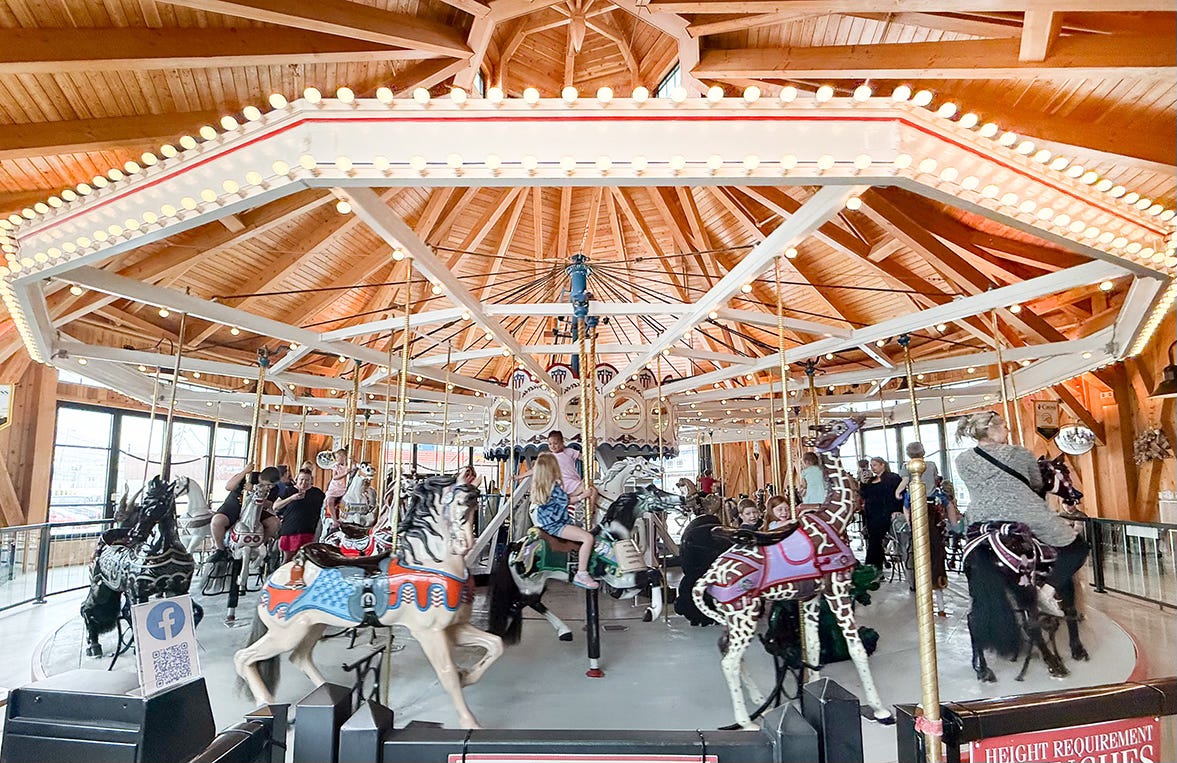
Thanks to the concerted efforts of a dedicated group of visionaries, the Salisbury Beach Carousel is again bringing squeals of delight and kinetic energy to the midway. And it’s not just any carousel, but an historic and lovely piece of genuine Americana that beckons beachgoers.
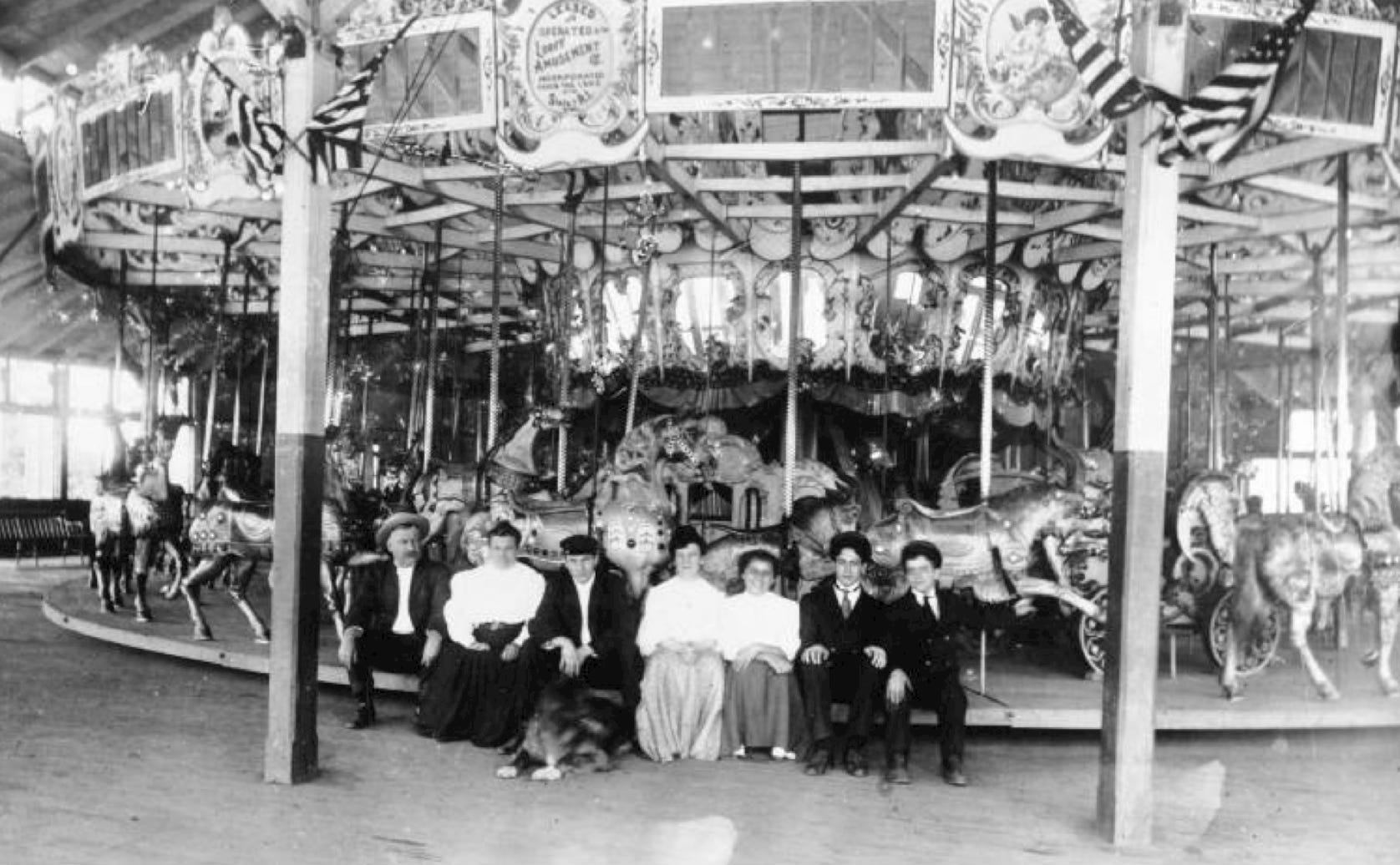
Before we get to the current-day carousel, let’s explore some Salisbury Beach history. Its trajectory follows a similar path as other seaside amusement areas in the U.S. Starting in the mid-1800s, hotels, restaurants, and, of course, the beach itself drew visitors that arrived first via steamboats and ferries. Then, as now, its ocean breezes and cool waters offered refuge from summer’s often-stifling heat and humidity. In the late 1800s, amusements started to be added to the mix of diversions, including the first carousel, Culver Flying Horses. When it was destroyed by fire, the ride was replaced by the Broadway Flying Horses, which began welcoming guests in 1914. The hand-carved gem was built by the Looff Carousel Company and originally debuted in 1890 at Coney Island in New York City.
Other coasters preceded it and followed it, but the Wildcat was the reigning king of the midway at Salisbury Beach. According to rcdb.com, it was installed in 1922, although other sources say its debut was a few years later in 1927. The classic out-and-back ride, which was first known as Comet, was created by noted coaster designer, Herbert Schmeck, and built by the Philadelphia Toboggan Company. In a fascinating aside, the Wildcat was commissioned and operated by the Dodgem Corporation. Yes, that Dodgem company.
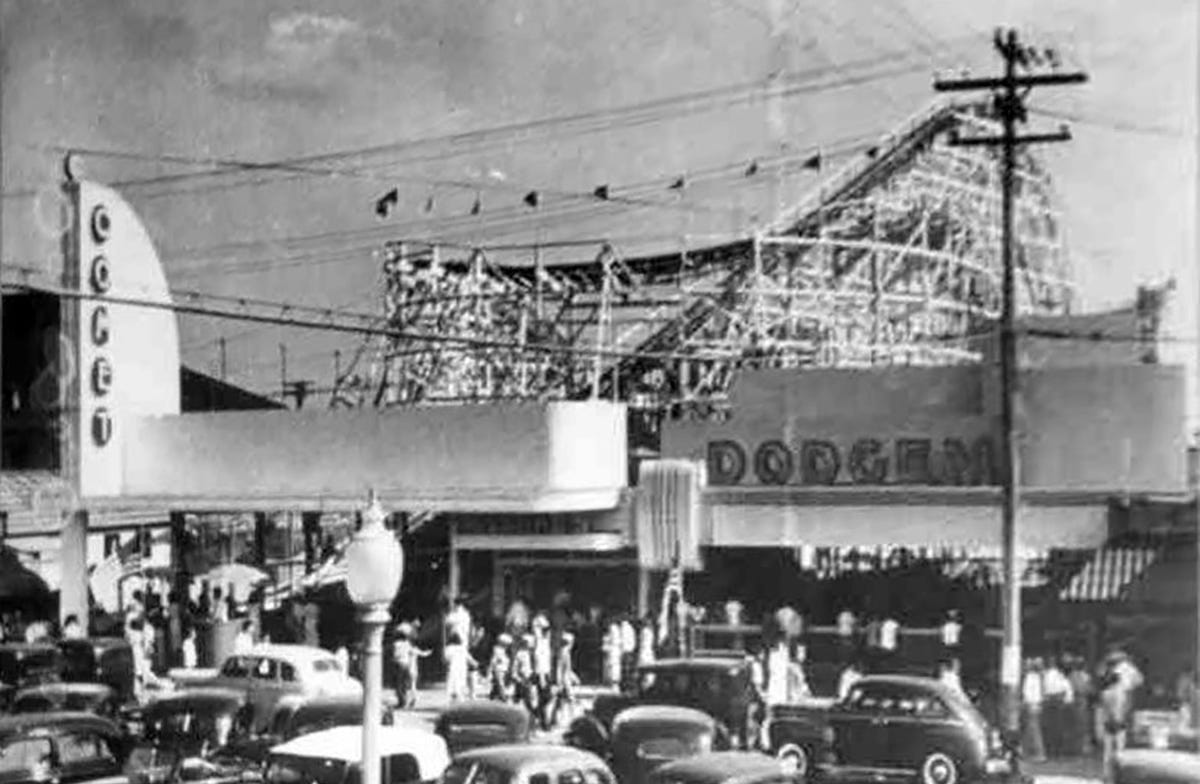
Located in nearby Lawrence, Massachusetts, the pioneering company installed its very first bumper car ride at Salisbury Beach in the early 1920s. The Dodgem folks had the coaster built next to the bumper cars, and the two rides shared a common entrance which featured stylish Art Deco lettering.
In the first half of the 20th century, the amusements expanded and thrived at the beach. In the 1960s, when I began visiting the beach, there were open-gate amusement parks, including Shaheen’s Fun-O-Rama, as well as a host of independent concessionaires. By the time I took my first ride on Wildcat in 1974, the Salisbury Beach amusement area was experiencing a long, sad decline. With the advent of the automobile and the mobility it offered and later, the introduction of Disneyland and more modern theme parks, tastes changed and attendance waned at places like Salisbury Beach. The Wildcat closed after the 1975 season, and the Broadway Flying Horses stopped spinning in 1976.
The amusements continued to fade at Salisbury Beach. Pirate’s Fun Park, which offered a small collection of rides including a Ferris wheel, go-karts, and the old-school Kastle Frankenstein dark ride, hung in there until 2004. Condominiums encroached on the amusement area, which became eerily quiet.
With less to do, fewer folks made the trek to Salisbury Beach. The handful of merchants and property owners that remained banded together about 17 years ago to promote the area and attract visitors.
The Salisbury Beach Partnership was formed “to revitalize the area–not to get it back to what it once was, but to get it to what it can be in the present day and age,” says Paul Descoteaux, one of the organization’s board members as well as the operator of the new carousel and the pavilion building that houses it.
One of the group’s first goals was to get a boardwalk built. In 2017, the organization celebrated the opening of the 625-foot-long oceanfront span. The organization then turned its attention to the beach’s legacy as a beloved amusement area and determined that it wanted to bring a carousel back to the midway. The group first tried to track down the Broadway Flying Horses. After it left Salisbury, the carousel made its way to Shoreline Village in San Diego in 1977 where it operated until 2004. It then went into storage.
By the time the Salisbury Beach Partnership tried to reclaim its crown jewel, some of its figures had been removed and sold individually to collectors. It is a fate that has befallen many of the grand carousels that were built during the ride’s golden age. So the partnership shifted gears and looked instead for a similar vintage ride. It hit the jackpot in Pennsylvania.
The Wintersteen family operated a carousel for over 90 years at Don Hanson’s Amusement Park on Harvey’s Lake in Pennsylvania. The park closed in 1984, and the carousel was relocated to Old Town in Kissimmee, Florida near Disney World for a period. When the Salisbury group was seeking it, the Wintersteen family had it packed away in a warehouse.
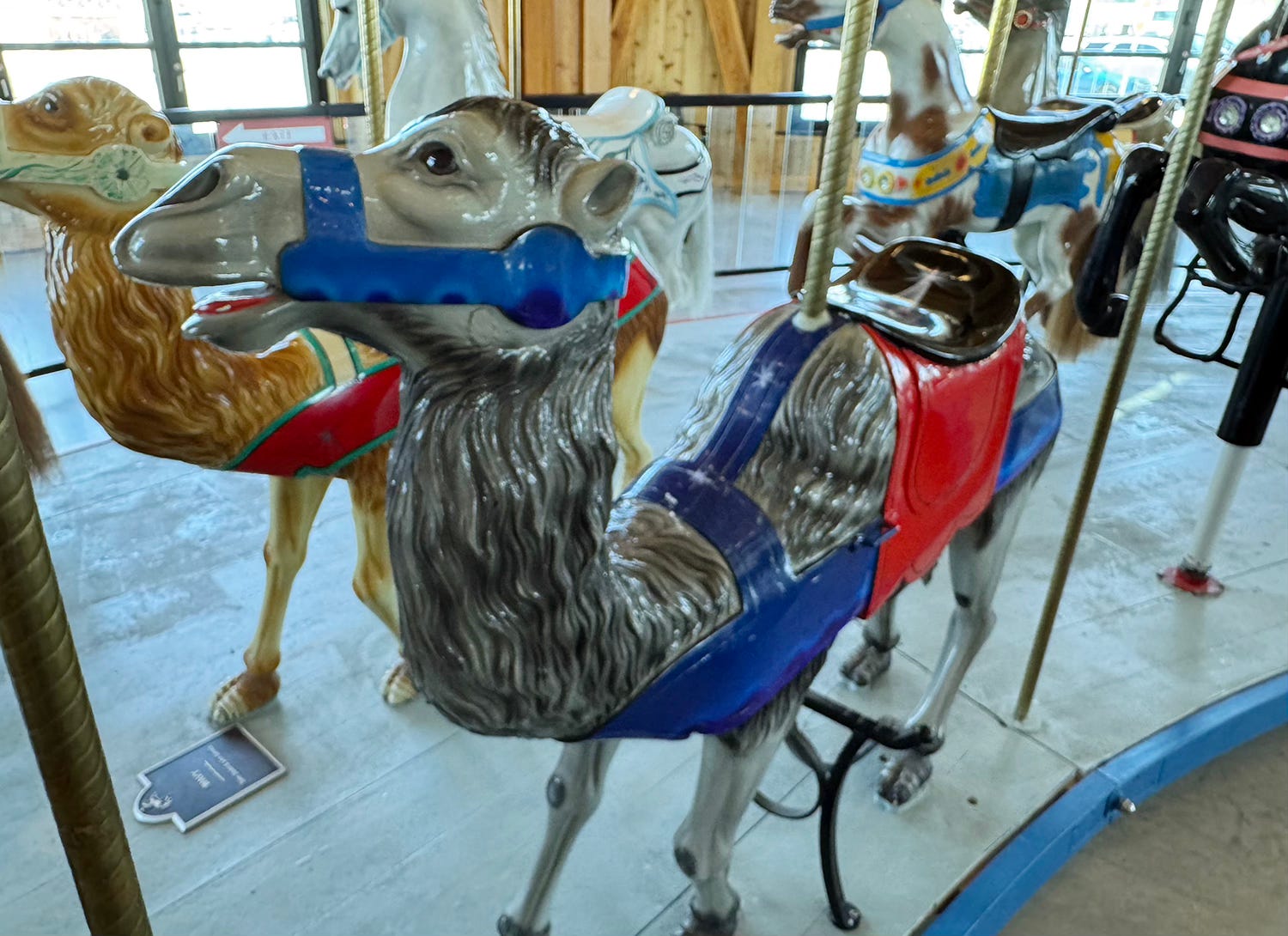
Although it was the third highest bidder, the family accepted the beach organization’s offer. The reason? The other bidders wanted to break up the ride and sell it in pieces. The Wintersteens wanted to see their prized carousel remain intact and continue to bring joy as a functioning ride.
“We couldn’t sign the paperwork fast enough,” says Descoteaux. “We were so very happy with what we got. [The Wintersteens] were ecstatic about it as well.”
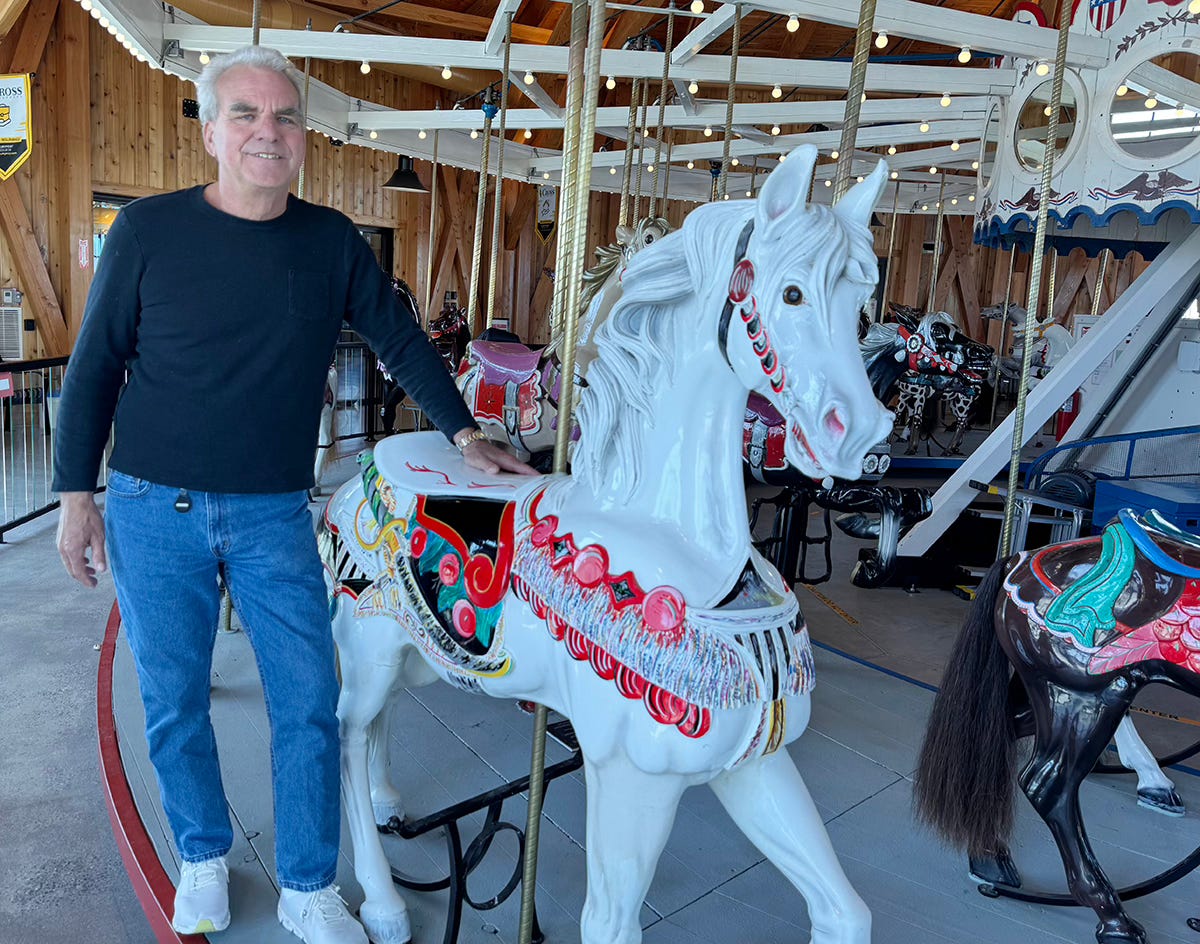
The carousel dates back to 1909 and, like the Broadway Flying Horses, was also designed and built by the Looff Carousel Company. The 44 figures on the three-row ride showcase the old-world craftsmanship that defined classic carousels such as this one. Known as a “menagerie” machine, it includes animals such as giraffes and zebras as well as horses. While the original ride was powered by a steam engine (which the Partnership obtained when it took possession of the ride), a modern-day electric motor now keeps the Salisbury Beach Carousel turning. A lift can accommodate guests in wheelchairs. The group was unable to get the carousel’s original band organ, although it is hoping that it will be able to someday obtain one.
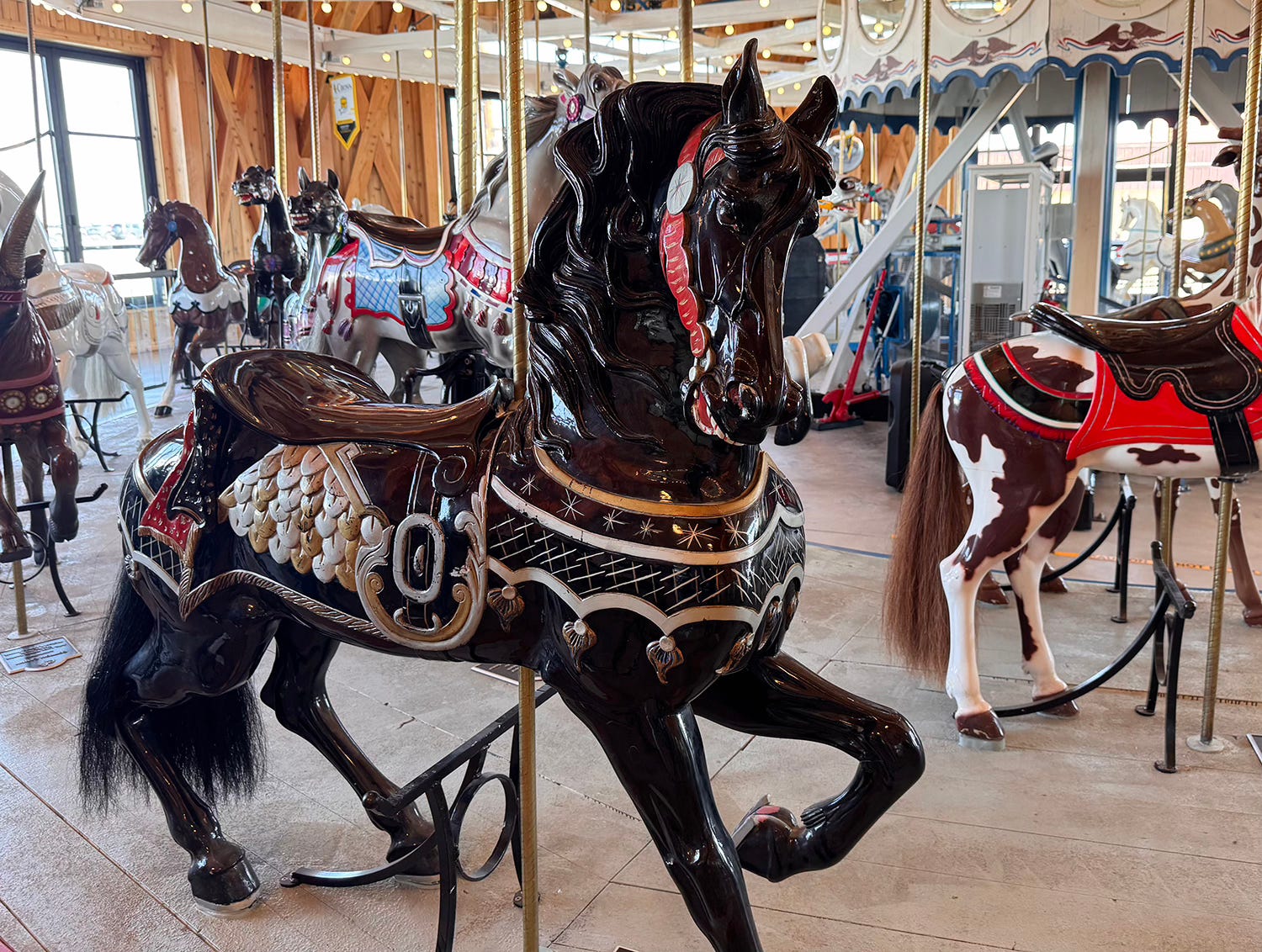
The carousel is housed in a lovely octagonal, post-and-beam building. It includes radiant floor heating–another one of the Partnership’s goals is to make Salisbury Beach a year-round destination–but in the summer, the pavilion’s expansive doors are opened wide to let the ocean breezes in and the joyful ambiance out onto the midway. The building includes a separate function room, and tables can also be arranged around the carousel for large events such as weddings.
“As corny as it sounds, this is a magical building,” Descoteaux says. People love sharing their memories about the former Broadway Flying Horses and the many other rides and attractions they experienced at the beach, he adds. “Now we are creating new memories with our carousel. The tradition goes on.”
Unlike many other seaside amusement areas, which often lose any semblance of their character once the rides go away, the merchants that remain carry on the spirit of Salisbury Beach. After guests take a ride on the carousel, they can head over to Joe’s Playland where Skee-Ball, classic pinball machines, and other games await. They can also scarf down some of the world’s greatest thick-battered onion rings, try some “beach pizza” (which, curiously, hardly has any cheese but can be topped with a slice of provolone for an extra charge), or head to Wiley’s, which has been serving scrumptious hand-made candies and ice cream since 1913. There are some wonderful sit-down restaurants in addition to a number of other quick-service food stands. While the Frolics, a huge nightclub that hosted famous big bands in the 40s and 50s and rock acts after that (and may or may not have been the site of my underage drinking escapades), is long gone, the Blue Ocean Music Hall now welcomes national and local performers in its beautiful venue.
So, what are you waiting for? Take the Salisbury Beach Carousel for a spin. There’s plenty of merry to go round.

On a related note, for folks in the New England area (or vacationers who will be visiting), please consider coming to Salisbury Beach on July 6, 2026 to check out the band I am in, Express (and to ride the carousel, of course). We will be performing outdoors from 7 p.m. to 9 p.m. on the Oceanfront Stage as part of the free Bands on the Beach summer concert series.
Are you a fan of antique carousels? Have you been to Salisbury Beach?
Just when I thought you couldn’t get any cooler Arthur, I find out you’re in a band!?! That’s awesome - what do you play? I work as the purchaser for an independent music store here in KY, so if you need the hookup on some gear, let me know!